


Physical environment monitoring and control
The refrigerator compressor stopped at 2 AM. The server air conditioner broke down on Saturday. The generator went silent at a remote site. Each time, the owner found out about it in the morning, when the damage had already been done.
We install industrial sensor systems that monitor the condition of the object 24 hours a day and send a notification within one minute of a problem occurring. Not the next day. Not from an employee. From the system, to your phone, at the moment when it is still possible to fix something.
Innocom designs, installs, and services monitoring systems for commercial and industrial facilities throughout Tbilisi and Georgia.
What does the system control?
Temperature. Server racks, refrigeration chambers, greenhouses, wine cellars, incubators. Continuous measurement with notification when it exceeds the permissible range.
Humidity Server rooms where condensation destroys equipment. Pharmaceutical warehouses. Wine cellars where 60-80% relative humidity is critical for proper aging.
Power supply. Mains voltage, UPS status, battery charge level, switch to backup. You'll know about shutdowns before they become a problem.
Exhaust fumes. Early detection in server, storage, and technical rooms. Integrated into the same message chain as temperature and power.
Access control. Sensors installed on the doors of server cabinets, refrigeration chambers, and restricted areas. They record every opening with a timestamp, without video surveillance.
Automatic restart. A stuck or frozen device is remotely rebooted without the need for an engineer to be dispatched on site. At unmanned facilities, this single function saves thousands of lari per year on emergency callouts.
How does this work?
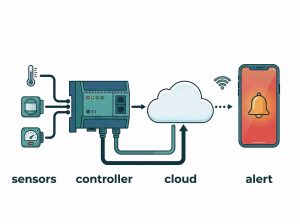
Industrial sensors are installed at critical points: in server racks, on the walls of refrigeration chambers, near electrical panels, on doors. Each sensor is connected to a wired controller via Ethernet or RS-485.
The controller collects data and transmits it to the cloud platform via Ethernet or, for remote objects without wired internet, via a 4G mobile network. Each controller has its own uninterruptible power supply: data transmission continues even in the event of a power outage.
You see real-time indicators on the web panel and in the mobile application. If any parameter exceeds the limit, you will receive an SMS, email or phone call within 60 seconds. The system stores all data and allows you to export PDF reports for HACCP audits, inspections and internal analysis.
For which objects?
Server and data centers. Server +35°C on a Tbilisi summer weekend: thermal shutdown, failed drives, corrupted backups. Monitoring detects a cooling failure before the equipment overheats.
Warehouses and cold chain. HACCP requires documented temperature control at critical points. The automated system replaces manual logs and issues an audit report at the request of the inspector. According to Georgian food safety legislation, fines for violations range from 3,000 to 5,000 GEL, with possible suspension of activities.
Restaurants and hotels. A refrigerator that breaks down at night can cause 3,000-8,000 GEL worth of products to spoil. The monitoring system sends a notification before the temperature enters the danger zone, above 5°C.
Greenhouses. Temperature, humidity, CO2, soil temperature. The system can automatically turn on ventilation, heating, or CO2 supply via relay modules. Microclimate optimization increases yields by 15-25% according to agronomic studies.
Poultry farms and incubators. A 0.5°C temperature deviation over a few hours destroys an entire batch of eggs. The cost of one lost batch exceeds the cost of the monitoring system.
Winemaking. White wine fermentation temperature: 12-18°C, red: 22-28°C. A 2°C deviation changes the taste profile. For exporters, the system ensures documentation of storage conditions in accordance with EU requirements.
Unmanned security facilities. Hydroelectric power plants, substations, pumping stations, telecommunication towers. 4G connection, autonomous power supply, automatic equipment restart. Staff presence is not required.
Pharmacies and pharmacy chains. GDP compliance requires continuous temperature recording. Automated reports replace manual records for regulatory inspections.
How we work?
One-time project: Object audit, system design, equipment supply, installation, configuration, testing. Typical implementation: 1 to 5 days, depending on the scale.
Monitoring Subscription (MaaS): Automatic control 24/7, instant notifications (SMS, email, call), personal control panel, data storage, periodic reports for auditing, sensor maintenance and battery replacement.
You can start with a one-time installation and subscribe later, or combine both formats at the same time.
Our experience?
BTU (Georgian-American University): Monitoring of campus server rooms. Temperature, humidity, power, and access control, 24/7.
Step 2: Temperature monitoring in food distributor's refrigerated warehouses, 24/7. Automatic notifications in case of deviations from HACCP ranges.
PS Energy: Remote object of 12 energy companies. Complete monitoring set: temperature, smoke, power, access, UPS status, and automatic reboot of jammed equipment.
Marshe Products: Monitoring storage conditions in a food production facility. Temperature and humidity control with reporting for inspections.
Nikora: Monitoring storage conditions in the trading facilities of one of the largest retail chains in Georgia.
Frequently Asked Questions
Within 60 seconds of exceeding the limit. The notification arrives via SMS, email, or automated phone call, depending on the configuration.
Not necessarily. At facilities without stationary internet, the controller transmits data via 4G. Standard Ethernet is used at facilities with existing network infrastructure.
Yes, this is one of the main scenarios. The system operates autonomously, notifies remote personnel, and restarts frozen equipment on-site without human intervention.
The system automatically creates temperature logs with time markers, which can be exported as PDF reports. When checking food safety, the data is visible directly from the phone. This eliminates the production of manual records and the risk of incomplete or falsified logs.
Battery-powered sensors last 5-10 years. Wired sensors do not require consumables. When you subscribe to our service, we provide periodic inspections, calibration, and battery replacement.
Yes. The controllers support Ethernet, RS-485, SNMP, MQTT, and Modbus. If Innocom built yours Server or network, the integration is happening quickly because we are already familiar with the object architecture.
All indicators are stored in the cloud with a configurable retention period. We recommend a minimum of 2 years for HACCP and GDP compliance. Data can be exported to PDF or CSV at any time.
Yes. Each controller has a built-in UPS with a battery. In case of a power outage, the system continues to monitor and sends notifications via 4G until the battery is depleted.
Email us
From technical task to working system
We create IT infrastructure for the real needs of your business, not according to templates. System design, installation, and configuration where reliability and thoughtful architecture are important.
Contact us

Phone: +995 555 11 05 50
Email: info@innocom.ge

Address: Tbilisi, Tsotne Dadiani 7, office A427
Let's consider the problem Describe your requirements and we will prepare a solution for your facility.