


Blog
Physical environment monitoring: How to protect a facility without permanent staff

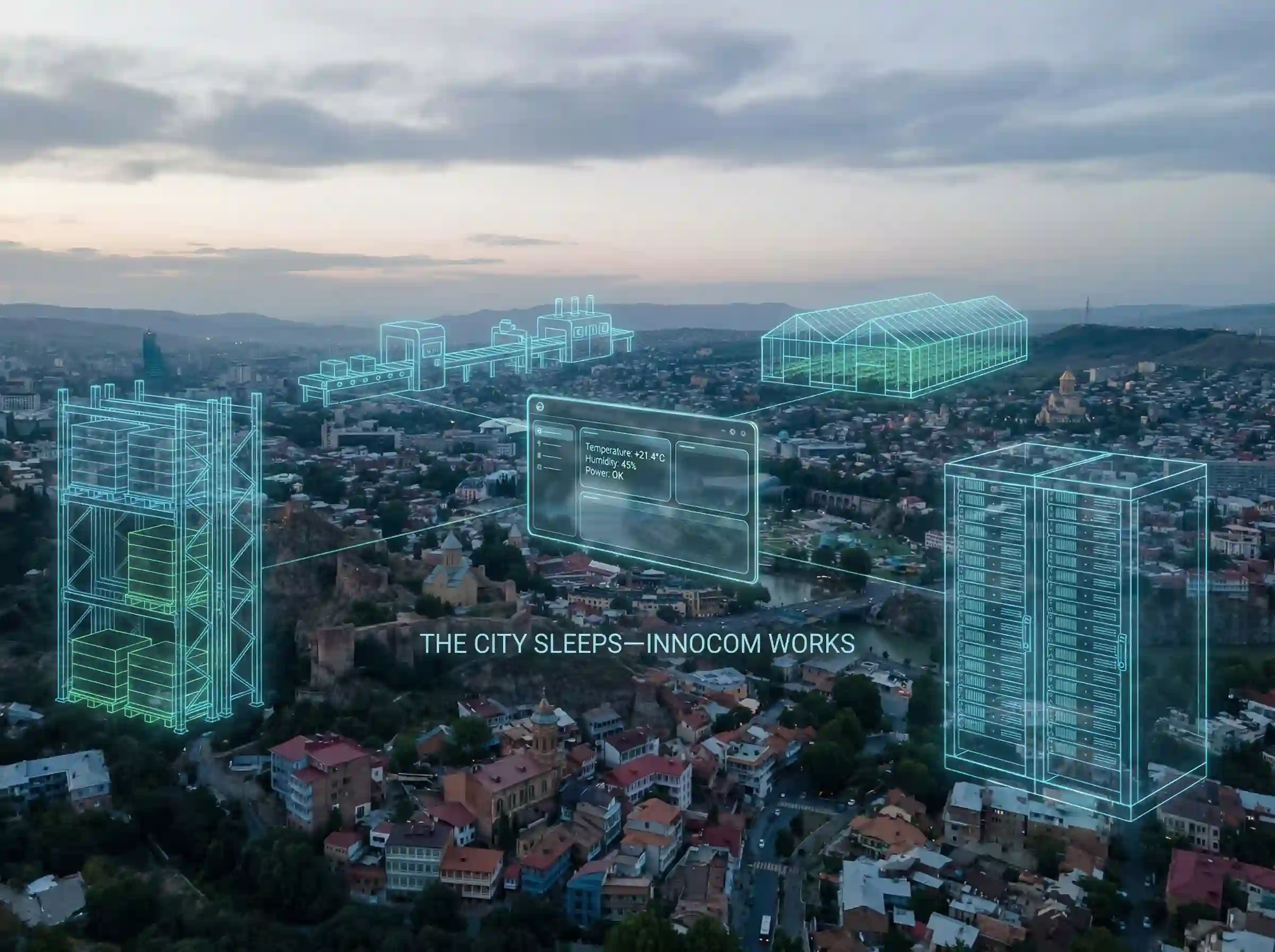
Tbilisi, Spring 2026. A few weeks remain until the "peak season," but businesses working with the cold chain, server infrastructure, or remote technical facilities are already making decisions that the summer will depend on. June's +35°C in the city means: refrigeration compressors are working at their limit, servers are heating up faster than usual, and greenhouses outside the city require round-the-clock attention. It is during this period that most incidents, which could have been avoided with a few thousand lari, turn into tens of thousands of lari in losses.
This article is a detailed guide to professional monitoring of the physical environment: what is controlled at different types of facilities, what components the system consists of, what technical solutions are used in practice, what Georgian legislation requires — and what specifically happens in those moments when a sensor detects a deviation from the norm.
Why is a remote object a separate task?
There is a fundamental difference between an office with an IT department and any facility where there is no permanent staff.
In an office with employees, a problem is quickly revealed: someone smelled burning, noticed a puddle under the air conditioner, saw a flashing indicator on the shelf. A person nearby is the best sensor possible. They react immediately, call the right people, and make decisions on the spot.
Let's remove this person now.
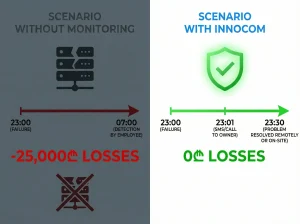
A food company warehouse 30 km from Tbilisi. The last employee leaves at 7:00 PM. At 11:40 PM, the refrigerator chamber compressor breaks down. The temperature inside begins to rise: from -18°C to -10°C, then to -4°C, then above zero. By 7:00 AM, when the first employee arrives, a batch of products worth several tens of thousands of lari is no longer suitable for sale.
Server room in a bank branch. IT specialist works in the main officeOn Saturday at 2:30 PM, the air conditioner breaks down. The servers continue to operate, the temperature on the shelf rises from a working 22°C to 35°C, then to 42°C. On Sunday morning, several servers go into protective shutdown. Monday begins with employees unable to access the system, and management learns the reasons several hours after the start of the workday.
Incubation workshop at a poultry farm in Kakheti. On Friday night, the electricity is cut off for three hours. The temperature in the incubators drops from a working 37.5°C to 31°C. The owner finds out about this on Saturday morning when he arrives at the facility. A batch of 2000 eggs is lost. This is three weeks of the incubation cycle and the value of the batch itself.
In all three cases, the problem was solvable — if they found out about it within the first 15–30 minutes. The compressor can be switched remotely or by calling an emergency team. The server room can be cooled with a portable device before a service employee arrives. The generator can be started remotely or delivered within an hour. There is always a response window — the only question is whether anyone knows about the problem at the necessary moment.
This is where the conversation about physical environment monitoring begins — not as a technical toy, but as an early detection system that works when people are not around.
Georgian market specifics
Local specifics are added to universal risks. The instability of the power grid in Georgia is not a rare exception, but a regular reality. Local outages occur without warning in certain districts of Tbilisi, at any time of the day or night. December 2025 showed that even large-scale accidents on high-voltage lines are possible, affecting tens of thousands of subscribers at once.
The situation outside Tbilisi is more difficult: In mountainous and remote areas, power outages are longer, and it takes much longer for the emergency crew to arrive. Poultry farms, vineyards, greenhouse complexes and small hydropower plants - they all operate in conditions where every hour without monitoring is an hour during which a problem can turn into a critical incident.
Moreover, most small and medium-sized enterprises in Georgia learn about problems after the fact: in the morning, when the first employee arrives, or later – when the consequences have already become irreversible.
Specifically what needs to be controlled: division by object types
Local specifics are added to universal risks. The instability of the power grid in Georgia is not a rare exception, but a regular reality. Local outages occur without warning in certain districts of Tbilisi, at any time of the day or night. December 2025 showed that even large-scale accidents on high-voltage lines are possible, affecting tens of thousands of subscribers at once.
The situation outside Tbilisi is more difficult: In mountainous and remote areas, power outages are longer, and it takes much longer for the emergency crew to arrive. Poultry farms, vineyards, greenhouse complexes and small hydropower plants - they all operate in conditions where every hour without monitoring is an hour during which a problem can turn into a critical incident.
Moreover, most small and medium-sized enterprises in Georgia learn about problems after the fact: in the morning, when the first employee arrives, or later – when the consequences have already become irreversible.
Specifically what needs to be controlled: division by object types
Different objects require fundamentally different monitoring parameters. What is critical for a server is insignificant for a greenhouse, and vice versa. Below is a detailed analysis by segment with specific technical requirements.
Server room
Server room — The object has the shortest allowable deviation window of all types considered. Modern servers begin throttling — forced performance degradation — at temperatures above 35°C and go into emergency shutdown at 40–45°C. The rate of heating when the air conditioner fails in Tbilisi in July — from a working 22°C to a critical 40°C — can be less than two hours. However, eight, ten, or twelve hours may pass before the first employee arrives in the morning.
Temperature — It is a key parameter, but it needs to be measured at several points. One sensor on the rack does not give a complete picture: the heat distribution in the server cabinet is uneven, and at the same average temperature, the top servers on the rack may overheat, while the bottom ones are normal. For a 3–8 rack server, a professional system provides for 4 to 6 temperature control points — at the cold air inlet and in the hot zone behind the servers.
Air humidity — This is a critical parameter that is often overlooked. At relative humidity above 60%, condensation begins on cooled surfaces and gradual corrosion of contacts. At humidity below 40%, the risk of electrostatic discharges increases, which can instantly disable sensitive components. Operating range for the server: 45–55%. This is especially true in Tbilisi, where it is +35°C outside in summer with high humidity, and the air conditioner creates a sharp change in conditions when entering the room.
Water leak — Under air conditioners, under false floors, in communication wiring zones. This is one of the most devastating incidents: a small leak that goes undetected over the weekend can disable hundreds of thousands of lari worth of equipment in 48 hours. Leak sensors are installed at floor level — they react to contact with water regardless of its quantity.
Electricity supply status — Mains voltage, UPS status, estimated battery runtime. A separate power sensor allows you to record the moment of the main power outage and calculate how much time is left before the batteries are depleted. This is key information for making decisions: is there enough time for a planned shutdown of the servers, or is it necessary to urgently call an emergency crew.
Access — The magnetic sensor on the server door and individual cabinet doors records the fact and time of each opening. For objects with physical security requirements — banks, insurance companies, telecommunications operators — this is a mandatory element of control. The access log allows you to accurately reconstruct the chronology of events when investigating an incident.
Exhaust fumes — The smoke detector in the server works in parallel with the building's overall fire alarm system, but provides earlier detection. The smell of burning from an overheating power supply or processor appears much earlier than an open fire. Early warning allows time for preventative shutdown and personnel call-out before the situation gets out of control.
What happens on a workday when a server room overheats? For a company with online operations – a bank, a logistics operator, a retailer – IT Infrastructure A one-hour outage costs much more than the value of the equipment itself. This is lost transactions, dissatisfied customers, reputational damage. Monitoring with 60-second notifications turns a potential disaster into a manageable incident.
Cold chain warehouse
Cold chain is one of the most strictly regulated aspects of the food and pharmaceutical business in Georgia. HACCP (Hazard Analysis and Critical Control Points) Mandatory for all participants in the food industry from 2023 and requires not only maintaining the temperature, but also its continuous documentation, in order to provide the regulator with data for any historical period.
National Food Agency (NFA) Implements It is authorized to conduct planned and unplanned inspections and to impose a fine of 3,000 to 5,000 GEL with the suspension of the production process for violation of the temperature regime. In case of repeated violations - cancellation of the license.
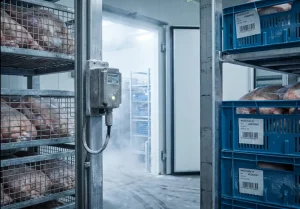
The temperature in each storage zone has a separate sensor for each chamber, not one common one for the entire warehouse. The temperature profile inside a large chamber is non-uniform: it is warmer near the doors, colder in the depths, and there may be local overcooling in areas near the compressor. For HACCP audit Data is needed on Critical Control Points (CCPs) that are identified during plan development.
NFA standards are specific: chilled products – no more than +5°C, hot dishes when served – no less than +60°C, frozen products −18°C. The system is configured with a two-level notification: a warning when approaching the norm limit (for example, when reaching −15°C for frozen products), a critical signal when it is exceeded (−12°C and above).
Humidity – For pharmaceutical product warehouses, it is regulated separately and is just as critical a parameter as temperature. Some categories of goods (biologically active additives, certain types of cosmetics) require humidity to be maintained within the range of 40–60%.
Access – The time and fact of opening the camera doors are recorded as a mandatory part of the HACCP log. This is proof that the recorded short-term temperature increase was caused by the planned opening of the door and not by equipment malfunction.
Power supply – for warehouses with a backup generator: Main network status monitoring, automatic notification when switching to backup, fuel level monitoring in the tank (if supported).
The main advantage for regulatory inspection: the system automatically creates a temperature log at a defined interval – every 10-15 minutes. During an NFA inspector's visit, the owner opens the application on their smartphone and shows a PDF report for any period: day, week, month, quarter. This is a database of evidence that cannot be filled in retroactively, which fundamentally increases the inspector's trust. In contentious situations, an automatic log with timestamps and system signature is an important legal argument.
Greenhouses and Agro-sector
Greenhouse farming is actively developing in Georgia: Tomatoes, cucumbers, greens, flowers, strawberries. This is a segment that traditional IT integrators practically do not consider as a target audience — and that is why there are almost no specialized solutions and competition in the monitoring niche here.
Key Feature: Greenhouse monitoring is not only protection against losses, but also a direct tool for increasing yields. Optimizing the microclimate based on sensor data provides a 15-25% increase in yield compared to manual control. This positive Arguments when selling: Not "protection from the worst," but "investment in the best."
Air temperature — In several points, because the microclimate inside the greenhouse is not uniform. At least two sensors per 500–1,000 sq.m greenhouse, three to four on larger areas. Critical moments: night frosts in early spring and autumn, when the temperature outside drops below zero, and the heating system must maintain a positive temperature inside. Turning off the heating system at night — and the crop is lost in a few hours.
Carbon dioxide (CO₂) It is one of the key parameters of plant growth. In the closed space of a greenhouse, the concentration of CO₂ can drop to atmospheric levels at night — about 400 ppm. With additional gas supply up to 800–1200 ppm, the rate of photosynthesis increases by 20–30%, which directly affects yield and ripening times. A CO₂ sensor with the ability to control the gas supply system is a direct investment in the farm's economy.
Air humidity — Exceeding the optimal range creates conditions for the development of fungal diseases: gray mold, powdery mildew, late blight. These infections can destroy an entire season's crop in 10–14 days. A humidity sensor with customizable notifications allows you to turn on ventilation before humidity levels reach dangerous levels.
Soil temperature — It's a separate parameter, especially critical for the root system in early spring. If the soil temperature is below +12–14°C, most greenhouse crops drastically slow down their growth, even if the air temperature is normal.
Lighting — For greenhouses with artificial lighting: control of the lighting level and automatic switching on of lamps when it falls below its threshold value, as well as fixation of the total daily light dose (DLI — Daily Light Integral).
Automation as the next step. A monitoring system with relay control modules allows you to move from monitoring to control: automatically turn on ventilation when the temperature exceeds, open windows, start watering or supply CO₂ without human intervention. This is a shift from reactive management to proactive management — and significant savings on manual labor.
Poultry farming and incubators
An incubator is an object that has the strictest requirements for temperature control accuracy. The permissible deviation for incubating chicken eggs is ±0.5°C from the working temperature of 37.5°C. This means that lowering to 37°C or raising to 38°C, lasting for several hours, puts the entire incubation cycle at risk.
The cost of placing 1000–2000 eggs in an incubator at a time ranges from 2000 to 5000₾, depending on the breed. The incubation period for chickens is 21 days. A three-hour power outage or a heating system malfunction can be equivalent to canceling a three-week cycle.
Temperature inside each incubator — with an accuracy of ±0.2°C. This requires specialized precision sensors — such as Pt100 with thermal compensation — and not standard temperature sensors for general purpose with an accuracy of ±0.5°C. The difference seems small, but for an incubator it is fundamental.
Power supply — voltage control sensor with instant notification upon mains failure. Not "notification in 5 minutes," but an instant call, because the owner has a limited time before the incubator's thermal inertia maintains the required temperature. For most incubators, this is 30–60 minutes — that's how much time is needed to bring a portable generator.
Humidity in the incubation workshop is a secondary but important parameter for egg storage conditions before laying and for maintaining conditions in the hatching zone.
CO₂ in poultry farms — In industrial poultry farms with high bird density, CO₂ concentrations exceeding 3000 ppm become critical and affect the health and survival of young birds. A CO₂ sensor with ventilation control is a must-have for serious farming.
Winemaking
Georgia is a winemaking country with a thousand-year history and is distinguished by its actively growing export volume. A modern exporting winemaker, who supplies products to European markets, works in conditions where traditional "eye and nose" control is no longer sufficient: buyers and certification bodies require documented data on compliance with temperature conditions at all stages of production and storage.
Fermentation temperature – working range for white and rosé wines is 12–18°C, for red wines 22–28°C. A deviation of 2°C affects the taste profile of the finished wine: higher temperatures accelerate fermentation and reduce aroma, lower temperatures slow it down and create the risk of fermentation stopping. Pt100 sensors provide accuracy sufficient for professional process control.
Temperature and humidity in the cellar – optimal conditions for aging and long-term storage: 10–14°C and 60–80% relative humidity. Deviation from these limits affects both the quality of the product and the rate of evaporation from the barrels (the so-called "angel's share"). For a farm with several hundred hectoliters in barrels, losses due to uncontrolled evaporation amount to tens of thousands of Lari per year.
For exporters: Automatic log of all parameters with timestamps and the ability to export to PDF – this is a standard requirement of buyers from Germany, the Netherlands, and Great Britain. Cold chain documentation during transportation is part of international certification standards.
Small hydropower plants and remote technical facilities
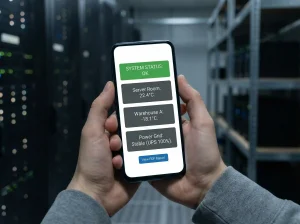
There are a significant number of private small and medium-sized hydroelectric power plants in Georgia, located in the mountainous regions of the country. The technical rooms of these facilities—transformer halls, control panels, machine rooms—are not staffed by permanent personnel and often lack a stable Ethernet connection. This is an extreme case of an "unattended facility," where a monitoring system is the only way to understand a problem before it causes an emergency shutdown.
What needs to be controlled:
Temperature in technical areas — overheating of transformer equipment due to ventilation failure or during hot periods.
Water leakage — in machine rooms, pump rooms, and areas where technological pipelines pass.
Electrical grid parameters — voltage and current at key nodes, deviations from the norm.
Unauthorized access is a particularly critical parameter for remote sites located in the mountains; a sensor attached to the machine room door records every opening with a timestamp.
Exhaust - Fire safety without permanent on-duty personnel.
Key technical requirement: complete independence from infrastructure. The system must operate via a cellular network (4G/LTE), have a directional antenna for operation in weak signal conditions, and autonomous power from a built-in battery that provides at least 48-72 hours of operation without external power.
How the system works: From sensor to call
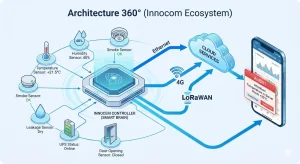
Understanding system architecture helps us make the right decisions when choosing a solution for a specific object. Any professional physical environment monitoring system consists of three layers.
First layer – Sensors
Sensors are data collection points. Each type measures a specific physical parameter and transmits the value to the controller via a wired protocol or radio channel.
Wired connection is a priority for stationary objects with permanent infrastructure. Industrial wired sensors (1-Wire, RS-485/Modbus protocols) operate for decades without battery replacement, are not subject to radio interference, and do not lose connection due to obstacles or ether congestion. Wireless solutions are convenient for temporary objects or where cabling is physically impossible, but in industrial applications they lag behind in reliability.
Sensor accuracy varies depending on the application:
- Standard temperature sensor: Accuracy ±0.5°C — sufficient for server, warehouse, basement.
- Precise Pt100 sensor: Accuracy ±0.1–0.2°C — for incubators, fermentation tanks.
- CO₂ sensors: Accuracy ±30–50 ppm in the 0–5000 ppm range — for greenhouses, poultry farms.
- Humidity sensors: Accuracy ±2–3% RH for most applications.
The enclosure protection rating is a critical parameter for wet and aggressive environments (refrigeration chambers, greenhouses, pumping rooms). An IP67 rated sensor can withstand direct immersion in water for up to 30 minutes. IP65 is protected against water jets under pressure. An unprotected sensor in a condensing refrigeration chamber will fail within a few months. Saving on the sensor's protection class is a false economy.
Sensor types in professional systems:
- Air and surface temperature (Thermocouple, Pt100, NTC, 1-Wire DS18B20)
- Humidity (capacitive sensor)
- Soil temperature (humidity-protected probe)
- CO₂ (Infrared NDIR sensor)
- Water leak (cable or point sensor)
- Smoke (optical or ionization)
- Network voltage (measuring transformer)
- Door opening (herkon / magnetic sensor)
- Motion (IR sensor, for perimeter security)
Layer Two – Controller and Data Transfer
The controller is the "brain" of the system on the object. It reads the sensors at defined intervals, stores the data locally in a buffer (in case of connection loss), and transmits it to the cloud.
Data transfer protocols:
Ethernet (TCP/IP) — For objects that have a ready-made cable infrastructure. If the server room is already connected to the network, the controller uses the same channel. Reliable, fast, without additional connection costs.
4G/LTE SIM card — For remote objects without stationary internet. The controller with a built-in modem and antenna works where there is cellular communication. For mountainous and rural objects, this is often the only viable option. Important point: in weak signal conditions (−100 dBm and below), the standard built-in antenna does not provide a stable connection. A professional solution involves a directional outdoor antenna.
LoRaWAN — For large areas where it is necessary to cover many monitoring points with minimal costs. Range up to 15 km in open space, sensors operate on battery for 5–10 years without replacement. Especially relevant for the agricultural sector: several greenhouses, fields, livestock complex, which are scattered over a large area. One gateway serves dozens of sensors.
RS-485/Modbus — Industrial wired protocol for integration with existing equipment: SCADA systems, industrial controllers PLC, building management automation systems (BMS).
Wi-Fi (802.11) — With wireless infrastructure available for small objects. Less desirable than Ethernet due to possible interference and instability, but acceptable for simple tasks.
Autonomy during a power outage is a critical parameter that distinguishes a professional solution from a household one. The controller with a built-in battery (Li-Ion, with a capacity of 2000 to 10000 mAh, depending on the model) continues to operate and transmit data even in the event of a complete power outage. That is why the system reports a power outage at the moment it disappears — and not when someone comes and discovers the problem in the morning.
Local data storage - the controller stores the indicators in non-volatile memory. In case of a temporary connection loss, the data is not lost and is uploaded to the cloud when the connection is restored. This is important for HACCP documentation: the continuity of the log should not depend on the quality of the Internet connection.
Third layer — cloud platform and messaging
Data flows from the controller to the cloud platform, where it is stored as time series. The minimum retention period for HACCP compliance is 2 years. Professional platforms store data for 3–5 years or more.
The board provides:
- Current values at all points in real time
- Historical charts for any period with arbitrary scaling
- All event logs: Notifications, Restores, Operator Actions
- Reports for audit - Export to PDF and CSV for the selected period
- Role-Based Access Control: Owner, Governor, Engineer, Auditor
Multi-level message:
First level — Warning. The parameter is approaching a critical threshold: for example, the temperature in the refrigerator has reached −14°C, while the norm is −18°C. A message is sent to the responsible manager. There is time for a preventive response: check the device, call a service specialist, and make sure the backup compressor is ready to start.
Second level — critical. The limit is exceeded. Immediate notification to all configured channels: push notification in the mobile application, SMS, email, voice call to several numbers simultaneously.
Escalation matrix — If the first recipient does not confirm the message within a specified time (for example, 5 minutes), the system automatically notifies the next one in the chain. This is critical during nighttime hours, weekends, and holiday periods.
False alarm protection is important for objects with dynamic conditions. The notification is sent not upon a single measurement, but after confirming the deviation in several consecutive measurements in a row (defined by the operator — usually 3–5 cycles). The refrigerator door was opened for 30 seconds — the system does not raise an alarm. The temperature rises for 10 minutes in a row — this is already a signal.
Message speed in professional systems — 60 seconds from the moment a deviation is detected until the message is received by the owner. This is not a theoretical figure, but a parameter that determines the real usefulness of the system during an incident. A system that notifies in 15–20 minutes is already useless in a number of situations.
Watchdog — Hardware Automatic Reset
The watchdog function deserves separate consideration because it is not present in most budget and consumer solutions. The hardware watchdog module connects to the power supply of the object's equipment and reboots it in case of freezing or loss of connection – without human intervention, without calling an engineer.
In practice, this looks like this: the router froze on a remote object and lost connection. Without a watchdog, the only option is to physically go there and reboot the device. This is several hours of time and the full cost of the call. With a watchdog, the module detects the loss of connection and after a specified time (usually 5–15 minutes) reapplies power. The router reboots, the connection is restored. No one goes anywhere.
For distributed object networks – small hydroelectric power plants, communication towers, remote warehouses, retail outlets – the watchdog function saves hundreds and thousands of lari per year on emergency call-outs alone. This is one of the most profitable functions for businesses with multiple remote objects.
Common mistakes when choosing a monitoring system
The market offers a wide range of solutions — from consumer household sensors for a few dozen lari to industrial systems for several thousand. The difference is not only in price. Below are the most common mistakes that lead to the fact that the installed system cannot cope with its task.
Error 1: One sensor on a large object
"Let's install one sensor in the center of the refrigeration chamber" is a common and dangerous simplification. The temperature profile inside a large chamber is not uniform: it is warmer near the doors by 2–4°C, and colder in the depth near the walls. One sensor records the "average temperature in the hospital" and may miss both overheating in one zone and overcooling in another. HACCP requires monitoring of critical control points, not average values.
Error 2: Household sensors in an industrial environment
Consumer temperature and humidity sensors designed for home use are not designed to operate at −20°C, in conditions of condensation or aggressive chemical environments. A housing without IP65/IP67 protection will fail in a refrigeration chamber in a few months. Accuracy of ±1–2°C, which is acceptable for a home thermostat, is not sufficient for HACCP monitoring.
შეცდომა 3: შეტყობინებები მხოლოდ ერთ ნომერზე
If a message comes only to one person's phone, and that person is unavailable (sleeping, driving, in a meeting, on vacation) - the response chain is broken. A professional system is configured with an escalation matrix: multiple recipients, automatic switching in the absence of confirmation.
Error 4: No local data buffer
A system that transmits data only to the cloud without local storage loses data when the internet connection is lost. This is critical for HACCP documentation: the log must be continuous, without gaps. A professional controller stores data locally and uploads it to the cloud when the connection is restored.
Error 5: Ignoring Autonomy
A monitoring system that shuts down with the main power is useless at the very moment it is needed most — during a power outage. The controller's built-in battery is not an optional feature, but a mandatory requirement for any serious application.
Error 6: Lack of Maintenance
Sensors age, calibrations change, contacts oxidize in aggressive environments. A system that was installed two years ago and has never been checked may show data with an accumulated error of several degrees — and at the same time not register deviations, because "everything is normal according to the readings." Regular maintenance is not an option, but a necessity.
Regulatory Requirements in Georgia: What You Need to Know
Businesses in various sectors of Georgia operate within different regulatory frameworks. Understanding the requirements helps you set up the monitoring system correctly the first time.
HACCP and NFA for the food sector
The HACCP system is mandatory for all participants in the food industry from 2023. Documentation requirements:
- Critical Control Point Continuous Temperature Log
- Data should be stored for a minimum of 2 years
- Ability to provide data at the request of the NFA inspector
The automated monitoring system fully covers these requirements. Manual logs, which are filled out "approximately once per shift," do not meet the continuity requirements.
GDP for pharmaceutical distribution
The Good Distribution Practice (GDP) standard for pharmaceutical product distributors requires documentation of storage and transportation conditions with data continuity and storage requirements similar to those. Violation of GDP carries the risk of revocation of the distribution license.
Requirements for Banks and Financial Organizations
The National Bank of Georgia sets requirements for the availability of IT systems. For banks and payment operators, monitoring server infrastructure is not only common sense, but also part of business continuity planning requirements.
Fire safety and technical regulations
Technical facilities without permanent staff – small hydroelectric power plants, transformer substations, pumping stations – are subject to the requirements of technical regulations regarding fire safety. Smoke and temperature sensors in these buildings are not only a useful function, but also a requirement of regulatory documents.
How to Choose a Monitoring Contractor: Evaluation Criteria
The IT services market in Georgia offers various options — from assembling a system from components independently to the services of specialized integrators. How to make the right decision?
What should a professional approach include?
Object audit before design. A reliable integrator starts with a site visit, not a price list. Without understanding the specifics of the object – layout, infrastructure, critical points – it is impossible to properly design the system.
Technical task in writing. The audit result must be documented: equipment list, sensor layout diagram, limit values, data transmission architecture, cost estimate. Verbal agreements are a source of future disagreements.
Experience working with industrial equipment. Installing sensors in a server room is significantly different from installation in a refrigeration chamber or at a remote facility without infrastructure. Ask the contractor about projects implemented in your industry.
SLA for technical maintenance. What happens if a sensor fails? How quickly will it be replaced? Who is responsible for the continuity of monitoring? All of this should be specified in the contract with measurable parameters and not in the form of general promises.
Scalability. If your business grows – objects are added, the warehouse expands, new points open – the system must grow with it. Clarify: is it possible to add sensors and new objects without changing the entire infrastructure?
Questions to Evaluate a Contractor
- What data transfer protocols does the system support — Ethernet, 4G, LoRaWAN?
- How long does the controller work in the event of a power outage?
- How many seconds after will the notification arrive in case of deviation?
- Where is the data stored and for how long?
- How is the escalation matrix configured in the absence of a response from the first recipient?
- Is there a watchdog function for automatic equipment reboot?
- How does the system integrate with the object's existing infrastructure?
Reaction Algorithm: What Happens After a Signal
Receiving a message and responding to it correctly are two different skills. A good system ensures the former. A properly configured response process is a joint task of the client and the integrator.
The First 60 Seconds
The notification goes to several responsible persons at once: the owner, the manager, the on-duty engineer — according to the escalation matrix. The notification contains specific information: object, measuring point, current value, deviation from the norm, event time. No abstract "an incident occurred" — only the data necessary to make an immediate decision.
Assessment: Real incident or false alarm?
The first question upon receiving a notification: is this a one-time event or an evolving incident? For this, you need to see the graph — how the parameter has changed in the last 30–60 minutes. If the value is increasing, it is an active incident that requires immediate response. If there was a fluctuation and the value returned to normal, perhaps the camera door was simply opened.
What can be done remotely, without visiting the site
- Reboot frozen device via watchdog module
- Switching to backup power supply channel via managed relays
- Connect with security or on-site personnel
- Call the emergency brigade with an exact description of the problem and its location
- Initiate planned server shutdown before UPS battery depletion
The role of IT outsourcing in incident response
IT outsourcing and technical support For companies working on a model, a monitoring system is a tool for SLA performance. Response Time and Time to Recover are specified in the contract and become measurable obligations, not just promises.
The difference between a "something broke, let's go see" type of call and a "compressor malfunction in zone B, temperature exceeded -5°C, a refrigeration service engineer with a spare relay is needed" type of call is several hours of lost time and a difference of several thousand lari in the cost of the incident.
Incident Documentation
Every message, every deviation, every operator action in the system is recorded with a timestamp. This is important for several reasons:
For HACCP: Documentation that a violation was recorded and eliminated protects the business during NFA inspections. "Yes, the temperature rose overnight, we received a notification at 02:31, an emergency call was made at 04:15, the regime was restored by 05:30" - this is a chronology to prove events, not just words.
For recurring incident analysis: If messages are regularly triggered at one point, it is not a coincidence, but a signal of the need for preventive maintenance of the device before the next breakdown.
Financial aspect: What is the cost of not monitoring?
The conversation about a monitoring system often starts with the question "What does it cost?". The right question sounds different: "What does one incident cost that this system prevents?"
Restaurant and cafe
In the refrigerator of an average restaurant, there are products worth 15,000–30,000 ₾. If the compressor breaks down overnight, the temperature inside exceeds +5°C in the morning — the NFA standard for storing perishable products. Everything that has been in abnormal mode for more than two hours is subject to write-off in accordance with HACCP requirements.
Direct damage: ₾3,000–₾8,000 in products per incident, depending on camera load. Indirect damage: If an NFA inspector discovers a violation without response documentation — a fine of ₾3,000 to ₾5,000 with possible suspension of activities.
One preventive incident per year fully compensates for the monitoring system, which costs from 3,500 ₾.
Cold chain warehouse
A large refrigeration chamber holds 30–50 tons of products. At summer temperatures, six hours without cooling — +35°C outside — puts the entire batch at risk.
Loss from one incident: from ₾50,000 and up, depending on the composition of the stored products. Additionally — contractual penalties for delivery delays, loss of reputation with clients, disposal costs.
For pharmaceutical product warehouses operating under GDP standards, every undocumented temperature excursion is a regulatory dispute and a potential revocation of the distribution license.
Server infrastructure
An hour of IT infrastructure downtime for a company with 50 employees is a loss of at least 50 working hours. Based on the average cost of a working hour in Georgian business, this is a direct operating loss of 500–2,000₾ due to lost work time alone.
For banks, payment systems, and logistics operators dealing with online transactions, the cost of downtime is much higher. Physical overheating of servers can lead to equipment damage – replacing a single server costs from 5,000 to 30,000₾ depending on the class. Recovering data after an improper crash shutdown is several hours to several days of work for specialists.
System cost in comparison
Basic set — server or small restaurant (2–5 sensors, controller, configuration, launch): from 3,500₾ one-time.
Monthly subscription for 24/7 monitoring with cloud storage, mobile app, and technical support: from 150₾ per month. Annually it is 1,800₾.
Enterprise Kit — One remote object with a full set of sensors (temperature, smoke, power, access, UPS, watchdog): approximately 5,000–6,000₾.
The economic logic is simple: a monitoring system is insurance through the accurate accounting of what it protects. Unlike classic insurance, it works on incident prevention rather than post-factum compensation.
How to Get Started: The Connection Process
Setting up a monitoring system is not about purchasing sensors and placing them "approximately where needed." A professional solution begins with understanding the object.
Step 1: Object Audit
A specialist visits the site. Critical control points are determined on-site: where sensors are needed, which parameters are critical for a specific business, what the data transmission architecture is — Ethernet, 4G, LoRaWAN.
Audit result — Written technical specification: a specific list of equipment, a diagram of sensor placement, limit values, cost estimate. This is a document, not a verbal agreement.
Timeframe from initial request to finalized technical specification: 2–5 business days.
Step 2: Design and Installation
Equipment is selected for a specific object based on the technical task. For those clients that Innocom has built for previously. Server room Or a cable system was installed, the audit requires minimal time: the object's infrastructure is already known, the connection scheme is obvious.
Installation at sites with ready-made cable infrastructure: 2–4 hours for the basic kit. More complex projects — from one day to several working days.
After installation: Setting message thresholds according to object-specific norms, testing all message channels, training the responsible person to work with the dashboard and mobile application.
Step 3: Launch and follow-up support
After the system is put into operation, the client receives access to a personal account and a mobile application. From this moment on, monitoring works in automatic mode: 24/7, without human participation, with automatic notification in case of deviations.
The service subscription includes: sensor maintenance, routine system checks, parameter updates when object parameters change, and emergency response in case of equipment failure within the SLA.
Order monitoring for your property
If you have an object without permanent staff — a cold chain, server room, greenhouse, incubator, remote technical room, or hydroelectric power plant — a physical environment monitoring system protects your business during the hours when no one is around.
Innocom - IT company in Tbilisi, with experience in implementing monitoring, server infrastructure, and IT outsourcing projects for small and medium-sized businesses in Georgia.
What you'll get:
- Free specialist visit and site audit
- Technical task with cost estimate — 2–5 business days
- Turnkey installation and staff training
- 24/7 monitoring with notifications in 60 seconds
- Technical service and support within the SLA
Call us, write to us, or leave a request On our website — We will offer you a solution that fits your specific object, not a standard price list.
Frequently Asked Questions
Within 60 seconds after the sensor detects a deviation from the norm. The notification arrives simultaneously on all configured channels: push notification in the application, SMS, email, voice call. The speed does not depend on the time of day — the system works equally well at 2:00 PM and 3:00 AM.
No. For facilities without stationary internet, the controller with a built-in SIM card works via 4G/LTE. For large areas — greenhouses, fields, livestock complexes — LoRaWAN is used with a range of up to 15 km. An object in the mountains without Wi-Fi and Ethernet is not a problem.
Yes. The controller is equipped with a built-in battery and continues monitoring even during a complete shutdown. Power outage is recorded as an event and sent as a notification within 60 seconds.
Complete. The system automatically records readings every 10–15 minutes and stores the data for at least 2 years. During an NFA inspection, the owner shows a PDF report for any period directly from their smartphone.
Basic kit (2–5 sensors, controller, configuration and launch) — from 3,500₾ one-time. 24/7 monitoring monthly subscription — from 150₾. The exact cost will be determined after an audit of the object.
Yes. All objects are visible on a single dashboard, and notifications come with a specific object and measurement point indicated. This is a key advantage for restaurant chains, warehouses in different areas, and distributed technical facilities.
Watchdog is a hardware module that automatically reboots a frozen device (router, controller, other device) without calling an engineer on site. For remote objects, this saves hundreds of Lari per year on emergency calls alone.